Simply a photo of a pretty flower.
I find it interesting that in the time since I snapped it, the vine has already died back and been pruned by the gardener. Today, there’s just an empty iron trellis there.
ɕ
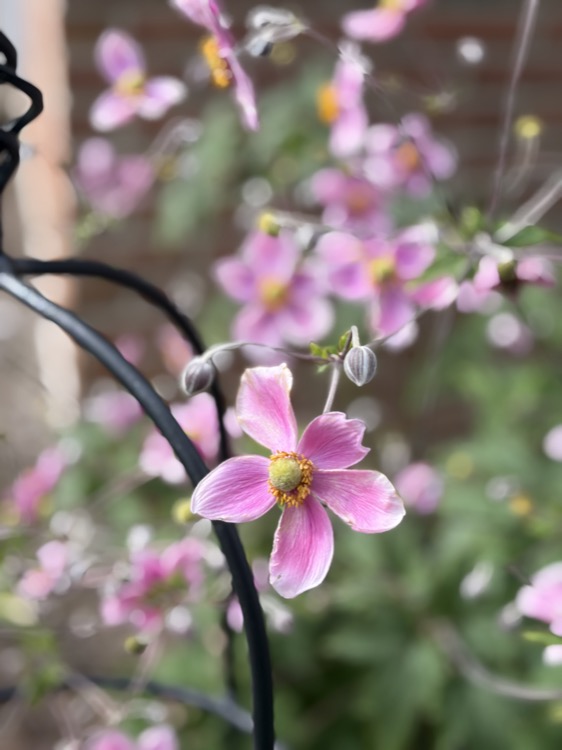
Simply a photo of a pretty flower.
I find it interesting that in the time since I snapped it, the vine has already died back and been pruned by the gardener. Today, there’s just an empty iron trellis there.
ɕ
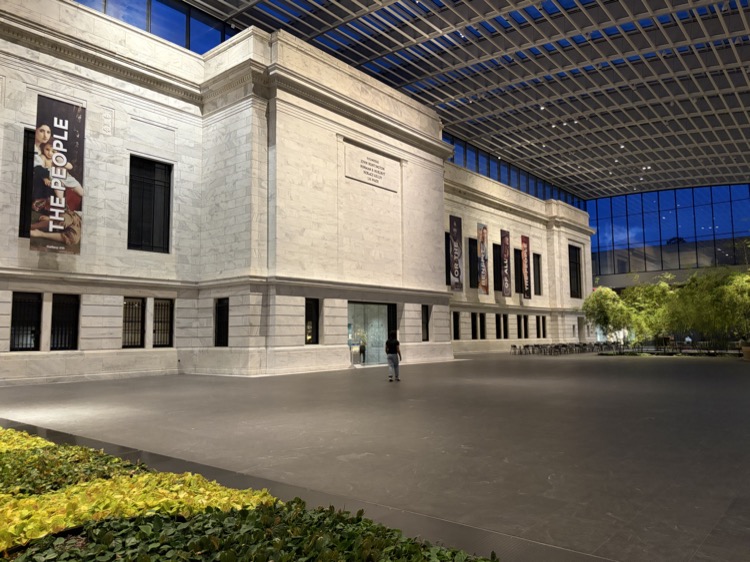
I simply like the way this looks. *snaps photo*
I was standing there imagining the original architects trying to figure out how big to make the museum. I’m sure the size of the grounds, budget, and probably even an existing collection that would go in the museum were all considered. The result of all that discussion was this classically American experience of a museum from that era.
I’m sure that at no point did anyone on the architecture team say: This size is good. If they need more room in one hundred years, they’ll just put a larger building over it and expand.
ɕ
Thanks, Apple. But I’m sure this isn’t what you intended.
My new iPhone keeps its display on. Always.
True, there are some situations where it’s smart enough to make the screen be completely off. Or maybe it’s just completely black. I’m not sure how these screens work now.
I bet Apple thinks always-on is a great feature. Because, now you can instantly see the time and notifications etc. and it’s all configurable! (You should read that in breathless, marketing-hype voice.)
Instead, what it actually does is remind me constantly that this thing is awake and eagerly awaiting its next opportunity to seize and monopolize my attention. It’s made it even more clear that this thing is hungry for the next opportunity to manipulate me. It sits perfectly still trying to look like calm technology, when in fact it’s a sleeping dragon ready to pounce.
Thanks, Apple, for letting a little wisp of smoke drift out of its nostrils.
…so that I never forget what it really is.
ɕ

Nothing in the portrait matches exactly what I think of as myself, yet somehow everything about it is exactly right.
Fox, I’m sorry that this took me so long to post!!
Months ago, I was contacted out of the blue by someone who asked to have a recorded conversation for something they called a soul portrait. Being a podcasting nerd, I interpreted their request to be about recording a podcast and I’m always up for a good podcast conversation, particularly when I can be the guest (because then I don’t even have to do any of the hard work.)
We had a fun, single-serving-sized conversation over Zoom where I answered a few questions… and then some time passed before Fox emailed me back.
I’ve looked at that soul portrait countless times, and every time it makes me smile, and brightens my day. My line at the top (“”) is what I wrote to Fox when I saw it. So many details came out subtly right… I didn’t wear glasses as a kid, but I do now; past me seeing future me. Dogs; you had me at “dogs.” Green, the tentacles, that crazy hair… all little details that came out from our conversation.
Thanks again, Fox
@soulportraitmuseum on Instagram
ɕ
This morning, reviewing my previous years’ journal entries I was surprised to see that my project to write Field Notes from my many podcast conversations (for Open + Curious, Movers Mindset, and Podtalk) is actually just one year old. It seems to me it’s been much longer than that.
Since day one, I’ve worked to improve the team of about a dozen separate LLMs — what I call cogitant personas — to create increasingly better writing.
Why?
Because I want to read these field notes. They are endlessly interesting to me as a way to look back across my conversations. They continuously find interesting moments I’d otherwise never get to revisit.
ɕ

Sometimes great macro shots are found even at Home Depot.
ɕ
https://overcast.fm/+AATXlFld6-4/1:12:18
Today in a call with Steve H and friends, I was reminded I’d sat on sharing this…
This is from On Being. Specifically from the unedited version: Krista Tippett releases the whole raw conversation alongside the produced show, and this one is with the poet Ocean Vuong, recorded on stage at On Air Fest in March 2020 — or, as she puts it, right before the world changed. After about an hour they opened the floor, and a producer and professor from Toronto — she uses those raw interviews as a teaching tool in her own classroom — asked Tippett a question about her own work rather than Vuong’s: how do you choose what to cut?
Oh, that’s interesting. Yeah. Well, so so you know, sometimes people who are younger ask me, “How did you start your podcast? And I say, “Well, we started a public radio show. And they look at me like, “You know, what am I talking about? So because you know, podcast didn’t exist when we started this. So interestingly, I mean, even I had to fight so hard, you know, those years ago. Even to say we’re going to do one conversation for the whole hour-that felt way too long form. People were very uncomfortable with it, and as a result, we’re on not prime time. I want to be quick because I want to get back to you. But at some point before podcasting, maybe right as podcasting came along, Lily’s here. Actually, it wasn’t my idea. One of my producers, Trent Gillis, at the time said that if we really believe in this value, virtue of transparency that we talk about, that the digital world is calling us all to, then we need to walk the talk. And it felt really counterintuitive, having been in media before this digital world. And I think we had this impassioned discussion for a year. I was like, “Why do we do all this work to get it down to 51 minutes if we’re going to give people the mess? And it is messy. I mean, it’s this is less messy. But if I’m in the studio with somebody and I have 90 minutes, I can let them go down some road that I really don’t know if there’s going to be anything there, but it’s okay because there might be, and if not, we can come back. We found with younger people, and we found that it gets used in like high school classes, and because we have they we give the raw, they trust the rest of the media project more. So that it’s been, and it’s huge. It’s hundreds of 1000s. I mean, I don’t know what the numbers are now, but it’s a very large percent, very large numbers of people in every show who listen to the unedited.
~ Krista Tippett
ɕ
It’s become clear that I have trouble moving beyond paradigms of thought which no longer serve me.
The example top of mind today is this line from my personal oath: I don’t compare myself to others, only to myself from yesterday. I adopted that oath eleven years ago. (I had to look that up.) In all that time, that line has felt rock solid. Comparing myself to anything has recently felt problematic.
ɕ
I really enjoyed this (it’s a rebroadcast from 2016) episode of On Being with David Whyte.
David Whyte is an English poet and philosopher, born to a Yorkshire father and an Irish mother, who trained as a marine zoologist and worked as a naturalist guide in the Galápagos before returning to poetry full time. He is best known for The Heart Aroused: Poetry and the Preservation of the Soul in Corporate America, and for Consolations, his book of essays on the underlying meanings of everyday words. In this 2016 conversation, he speaks about what he calls the conversational nature of reality — the frontier between what you think is you and what you think is not you — and about loss, vulnerability, aloneness, genius, and the strange work of bringing poetry into corporate leadership. Threaded through is his friendship with the late John O’Donohue and the grief of losing him. He recites four of his poems along the way.
https://onbeing.org/programs/david-whyte-seeking-language-large-enough/
ɕ
This is simply how my mind works. If I see a problem or a sharp edge which interests or annoys me… I get “distracted” (I argue that these distractions are actually the real things that I get done) and I go build, fix, repair, or remove entirely . . .
So I started something tiny for myself and it has just grown into — well, I had to create a Docent so when people ask me questions it can explain it in a way that I can’t. So imagine you and I are in a small museum and I brought you in through the employee entrance in the back and I just finished babbling at you about how it all works. So I can say, “…wait, I’m sorry. We have a Docent who can translate my crazy for you . . .”
At which point I woke up the Docent and prompted it with:
Good morning! I have a guest with me who asked me, “what is this project?!” (they’re shocked at its actual scale, confused by the complexity of the room, and don’t understand why the effort…)
~ Me
I hear a lot of fear and talk about AI slop, but this is what I’m getting from the LLMs I’m using…
(more…)